
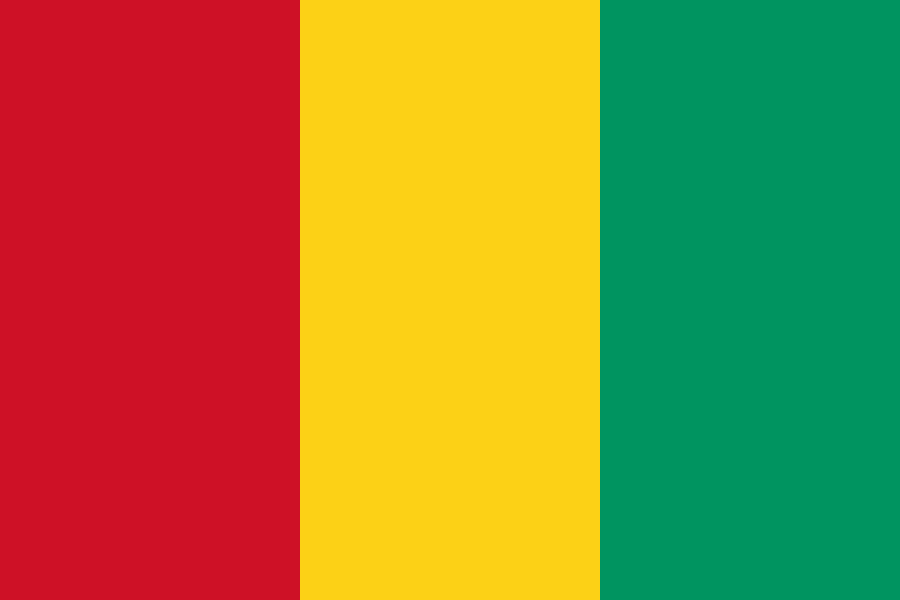
 Visa guide
Countries that Require a Visa for Guinea Passport Holders
Destinations where Guinean must obtain a visa from an embassy or consulate before travelling.
Nothing to show here
We don't have destinations for this filter yet. Try the full visa list.
General visa requirements & things to know before you travel
A general checklist of what most countries ask for when Guinean apply for a visa.
- A valid international travel passport
- A completed visa application form
- The applicable visa fee
- Evidence of permission to enter the destination country
- A photocopy of your passport data page
- Financial proof — an original bank statement
- A letter of invitation, where one is required
Exact requirements vary by destination and visa type — always confirm what your destination needs before you apply.
Visa information for other nationalities
Visa requirements for travellers from other countries visiting Guinea.












About Guinea
Formerly known as French Guinea and now sometimes called Guinea-Conakry, gained her independence on the 2nd of October, 1958. The country has an area of 245,860 square kilometers and has its capital city as Conakry which is the largest city in the country and has a population of 1,667,864.
Guinea’s economy is largely dependent on agriculture as it employs about 80% of the country’s population. It is also blessed with minerals including diamond, gold, and bauxite as it is the world’s second largest producer of bauxite.
Islam is predominant in Guinea as Muslims make up 85% of the population. Its official language is French although, other indigenous languages are being spoken in the country, Susu is the most commonly spoken language in Conakry. Rice, sorghum, millet, and cassava are common foods in Guinea which is usually eaten with sauce.
Children tend to work very hard at a young age, helping out with farm work and cooking and so, they do not attend schools especially the girls but mostly because their parents cannot afford their school fees and money for uniforms. Although there are universities in Conakry, scholarships are being awarded on a very competitive basis.
Guinea is one of the wettest countries in West Africa and so has a high amount of rainfall from June to November while the country experiences its dry seasons which comes with harmattan from December to May which is the best time to visit the country.
Malaria is prevalent in Guinea and it is the major cause of disability in the country. There is also a high case of HIV/AIDS which is mainly caused by unprotected sex and having multiple sexual partners. There was a serious outbreak of Ebola in 2014 which killed many people.
The use of taxis or cabs is common in Guinea as majority of the population use it to move around. Donkeys and horses are also used to transport things like construction materials. There are also airports in the country with Conakry international airport being the largest.
There are many tourist attractions in guinea but a few of them are listed below
- Centre d'Art Acrobatique Keita Fodeba: This is a place to watch acrobats spin, twirl, and flip. One would wonder if these acrobats have backbones.
- Centre de Conservation pour Chimpanzés: This is a place where you are guaranteed to see large mammals and chimpanzes that were rescued and are being reintroduced to the wild.
- Parc National du Haut Niger: This is the most protected area in Guinea. It covers about 1200 sq. km and has various species of wildlife including buffalos, gorillas and crocodiles.
- Loos Islands or Lies de Los: This is a group of Islands in Guinea. It is known for its beautiful forested interiors and it also has the best beaches in the country. There are various comfortable hotels to stay in when you visit Guinea.